|
 Loading the player ... |
Joseph Davidovits - The Construction of the Pyramids & Amenhotep, son of Hapu
April 17, 2011
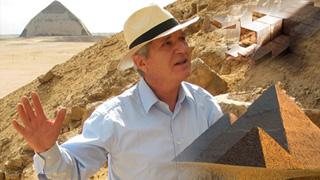
Joseph Davidovits is a French materials scientist who has posited that the blocks of the Great Pyramid are not carved stone but mostly a form of limestone concrete. He holds the Chevalier de l'Ordre National du Mérite (one of France's highest honors), is the author and co-author of more than 130 scientific papers and conferences reports, is the discoverer and inventor of the geopolymer chemistry and its technical applications and holds more than fifty patents. Joseph is a member of the International Association of Egyptologists. He presented several conferences on ceramics, blue faience, cements, pigments, and the analysis of pyramids stones at several International Congresses of Egyptology. In this program, Joseph will discuss how the pyramids of Egypt were built. He'll share his research and theories about reconstituted limestone and more. In the second hour with Joseph Davidovits we'll continue talking about agglomerated stone and lime stone concrete and discuss if other temples and monuments have been built using the same technique. Then, we discuss the "Merneptah Stele", - also known as the Israel Stele or Victory Stele of Merneptah - is an inscription by the Ancient Egyptian king Merneptah (reign:1213 to 1203 BC), which appears on the reverse side of a granite stele erected by the king Amenhotep III. It was discovered by Flinders Petrie in 1896 at Thebes. The stele has gained much fame and notoriety for being the only Ancient Egyptian document generally accepted as mentioning "Isrir" or "Israel". It is the earliest known attestation of the demonym Israel. Joseph has found evidence of an error or possibly an attempt at forgery by the original translator of the steel, Flinders Petri. Later, we discuss the Bible, Joseph son of Jacob and more on Amenhotep, son of Hapu.
|